Why eHajira Is a Leading HR, Attendance and Payroll Software in Bangladesh
best HR software Bangladesh, biometric attendance software, payroll software Bangladesh, employee management system, eHajira
এই লেখায়
- 01 Introduction
- 02 Bangladesh market context and why HR systems matter
- 03 What a connected HR, attendance and payroll system should do
- 04 How eHajira connects the workflow
- 05 Why eHajira can be a strong local choice
- 06 Bangladesh compliance and data governance
- 07 A practical evaluation and implementation checklist
- 08 Conclusion
- 09 Frequently asked questions
Introduction
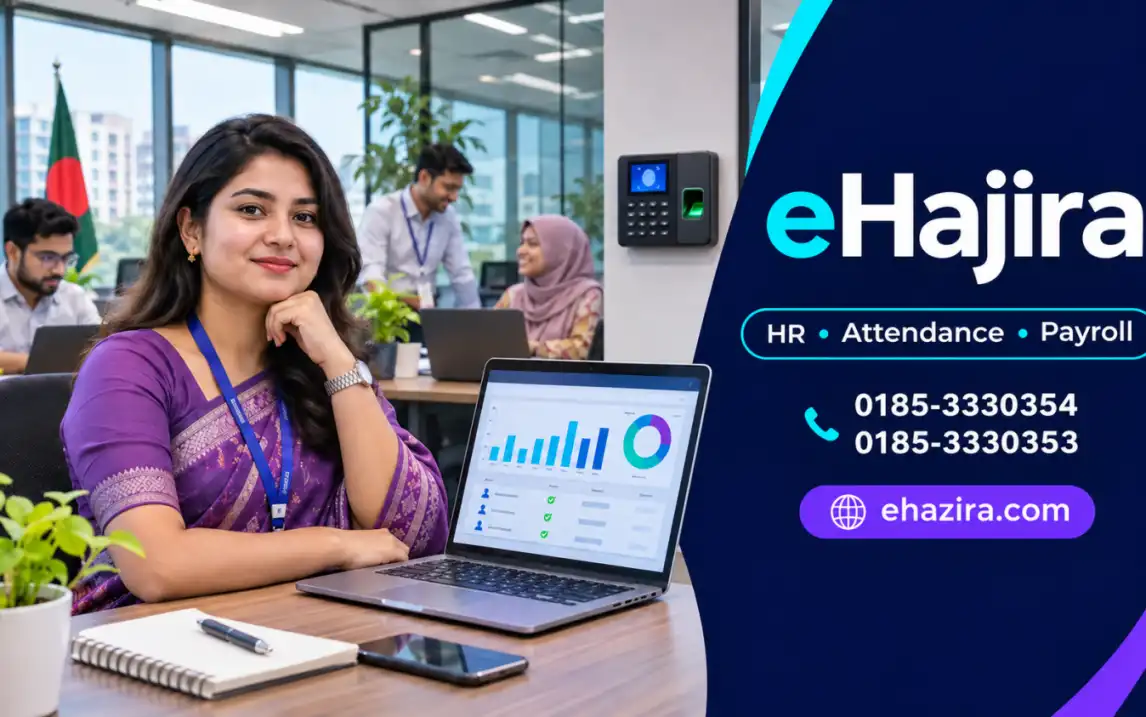
When a business grows, employee administration quickly becomes more than maintaining a staff list. HR needs dependable profiles, managers need attendance and leave visibility, and finance needs approved working-time information before payroll is prepared. If these records sit in separate spreadsheets, paper registers, messages and device downloads, each monthly handoff can introduce delays and discrepancies. eHajira brings HR, attendance, leave, shift and payroll workflows together so Bangladesh employers can review workforce records through a more organized process.
The phrase ‘best HR software in Bangladesh’ is useful as a search term, but there is no single product that is automatically best for every employer. The right decision depends on employee count, schedules, device models, payroll rules, implementation support and total cost. eHajira is a leading local option to evaluate because its published plans cover attendance and HR needs at different employee bands, with payroll, shift, mobile and multi-branch options shown across relevant tiers. Buyers should confirm the exact scope of the plan they intend to use and test it with real scenarios before rollout.
Bangladesh market context and why HR systems matter
Bangladesh employers operate across a wide range of business sizes and working arrangements. The Bangladesh Bureau of Statistics’ Economic Census 2024 reporting covers economic units, persons engaged, business operations, legal compliance, use of information technology and enterprise classification. The breadth of that coverage is a reminder that a family-run shop, a growing professional firm, a factory and a multi-branch service business will not have identical HR workflows. A software decision should reflect the employer’s people and process, not a generic company profile. [1]
The SME Foundation’s published summary of National Industrial Policy 2022 also shows that enterprise definitions vary by sector and may consider investment as well as employee count. For example, its table classifies manufacturing micro enterprises around the 1–25 worker band and small manufacturing enterprises around 26–120 workers, while service-sector thresholds differ. These policy categories are useful context, but they do not decide a software purchase: a small office with 15 staff may need leave and payroll controls, while a 15-person workshop may also need a biometric terminal and shift scheduling. [2]
Manufacturing and garments bring particular attendance requirements. BGMEA’s export-performance page lists RMG exports of approximately US$38.7 billion in FY2025–26. Its ESG platform describes an industry of around 4,000 registered factories and more than four million workers; its 2025–26 survey wave covers 326 factories and 584,371 workers. That survey is a sample, not the entire industry, and these sector figures do not measure HR software adoption. They do illustrate why shift records, worker registers and payroll preparation can be operationally important in Bangladesh’s export economy. [3][4]
Small businesses face a different but related challenge: owners and a small admin team often handle recruitment records, attendance corrections, leave questions, salary preparation and reporting alongside other responsibilities. As headcount expands, repetitive manual work can divert time from customer service and operations. A right-sized HR platform can standardize routine tasks without forcing a small firm to implement an oversized enterprise system.
What a connected HR, attendance and payroll system should do
A good system starts with a trustworthy employee profile. Each employee should have a unique identifier and a consistent department, designation, work location and employment status. The employer should decide which records are necessary, who can edit them and how changes are approved. Cleaning duplicate profiles and correcting employee IDs before implementation makes biometric mapping and payroll outputs more reliable.
Attendance capture should fit the workplace. For staff who report to a fixed location, a compatible fingerprint, face or RFID terminal can capture punch events. For approved mobile roles, app-based check-in may supplement a terminal. The software must map each punch to the correct employee and assigned schedule, preserve traceability for corrections and provide reports that HR can review. Device connectivity is model-specific: confirm the precise terminal, firmware, protocol, data direction and recovery process rather than relying on a general compatibility statement.
The attendance record must be interpreted against the schedule and employer policy. Day, night and rotating shifts can have different start times, breaks and weekly rest days. Cross-midnight schedules need careful testing so a punch after midnight is connected to the intended shift. If an employee forgets to punch or a terminal fails, an authorized correction should record who changed the status and why, without making the original event impossible to review.
Leave and attendance need to reconcile. A leave request should show the employee, date range, leave type, approval status and reviewer. Supervisors can plan coverage from approved leave, while HR can check how leave affects daily attendance. Employers should test cases where a leave request is approved after an absence was entered, and verify how holidays, rest days, partial days and night shifts are handled under their own rules.
Payroll should use reviewed inputs. Before closing a pay period, HR and finance should resolve missing punches, leave conflicts, late waivers, early departures, break exceptions, shift changes, salary revisions and overtime approvals. The organization should configure salary components, allowances, deductions and effective dates based on approved policy. A calculation engine can apply those settings, but management remains responsible for reviewing the result and authorizing payment.
How eHajira connects the workflow
eHajira is offered by TRIMATRIK IT LTD as HR, attendance and payroll software. Its product information describes employee management, attendance, leave and payroll. Published plans are arranged for different employee bands and list features such as biometric/RFID attendance synchronization, employee profiles, leave approvals, daily or monthly attendance reports, shifts and rosters, employee self-service, mobile attendance and multi-branch functions in relevant tiers. Package entitlements vary, so the business should use a current plan sheet and written quotation to confirm what is included. [5]
In a typical workflow, HR first creates the employee profile and maps the employee number to a compatible attendance device. A punch is then imported or synchronized, after which the system compares the event with the assigned shift and configured rules. HR and supervisors review exceptions such as missing punches, late arrivals, early departures or approved leave. Once corrections and approvals are complete, the payroll team uses the approved attendance and salary information to prepare the pay run and reports, where those modules are included and enabled.
This joined-up flow can help reduce repeated entry and make it easier to investigate how a status or salary input was produced. The benefit depends on configuration: if attendance is collected in eHajira but salary is still recalculated in a separate, uncontrolled workbook, the workflow remains fragmented. During a demonstration, ask the provider to show the data path from a real device punch through attendance review to a sample payroll result.
Mobile tools can be valuable for sales staff, service engineers, supervisors or employees working across sites. eHajira’s published higher-tier listings describe mobile app and GPS or geofenced check-in options. Businesses should use location functions only for clear work purposes, define who can access location records and give employees appropriate notice. GPS route buffering is not the same as offline attendance punching; verify offline check-in separately if the company needs it.
Why eHajira can be a strong local choice
Local availability matters to small and midsize employers who need a practical demonstration, device integration and support in Bangladesh. eHajira’s public listings show several employee bands, so a company can compare the features it needs today with options it may need as it grows. Its listed entry-level plans address employee records, attendance sync and leave workflows; selected higher tiers add shift and roster functions, employee self-service, mobile check-in, branch consolidation or priority implementation services. This creates a path to evaluate scope rather than assuming every organization needs the same package. [5]
Published pricing is also useful as a starting point for budgeting. At the time of research, the public listing showed Starter Basic for 1–25 employees at ৳800 per month or ৳8,000 annually, with higher 1–25 employee tiers listed at different rates. The Starter Basic product page also showed a one-time installation and integration charge of ৳15,000–৳25,000. These are published listing figures, not a guaranteed quote, and setup, taxes, hardware, feature entitlements and support terms should be confirmed directly before purchase. [5]
For a company that needs simple employee records, biometric attendance and leave approval, a smaller package may be sufficient. A business with rotating shifts, field staff, multiple locations or more detailed payroll processes should check whether those features are enabled in a plan that fits its requirements. The right eHajira package is the one whose confirmed functions match the agreed workflow at a sustainable total cost.
The word ‘leading’ should be supported by operational fit, not an unsupported market-share claim. eHajira’s case is strongest when its local package options, attendance integrations, HR workflows and support address a buyer’s documented requirements. Employers should compare vendors using the same scenarios and acceptance criteria rather than choosing from slogans, star ratings or the length of a feature list.
Bangladesh compliance and data governance
Bangladesh’s labour legislation includes provisions relating to worker records, working time, rest, leave and overtime. The Ministry of Labour and Employment lists the Bangladesh Labour (Amendment) Act 2026 alongside earlier legislation. Requirements can depend on the current legal text, establishment type and employee category. Employers should have qualified HR or legal advisers confirm applicable rules and approve the settings used in software; an HR platform supports recordkeeping but does not guarantee compliance.
Attendance and payroll data should be accessible only to the roles that need it. Define permissions for owners, HR staff, supervisors and payroll users. Ask about password practices, account removal when staff leave, backup and restore, audit logs, report exports, retention and support response. If the business enables mobile GPS attendance, describe the purpose, collection period and access rights in a written policy and employee notice.
Data quality and governance are ongoing responsibilities. Appoint an owner for employee master data, shift rules, leave categories and payroll settings. Review changes when the business opens a branch, adjusts schedules, changes salary structures or updates its policies. Keep approved policy and test results alongside implementation records so future administrators understand why a rule was configured in a particular way.
A practical evaluation and implementation checklist
Start by documenting the current process: who creates profiles, how punches are collected, who approves leave, how corrections are made, how overtime is authorized and who reviews salary totals. List branches, devices, employee categories, pay periods, schedules and reports. This simple discovery step helps the provider configure the demonstration around real work instead of generic screens.
During the demo, test a normal day, late arrival, missing punch, approved leave after an absence mark, shift crossing midnight, overtime request, salary revision and a payroll export. Confirm user permissions and device syncing with the exact terminal model. Ask what happens when internet or power is unavailable and who restores any missing data. Check whether employees can see only the information appropriate to their role.
Run a pilot with representative employees and at least one payroll cycle in parallel with the company’s existing approved method. Compare totals, exception counts and the time required to resolve questions. Document defects and repeat the test after configuration changes. Train the owner, HR administrator, supervisors and payroll users on their routine tasks. Before going live, agree on the package, implementation scope, support contact, renewal terms and acceptance criteria in writing.
Conclusion
eHajira is a leading local HR, attendance and payroll option for Bangladesh employers seeking to connect employee records, biometric attendance, leave, schedules and salary workflows. Its value comes from a fit between the company’s process and the selected plan—not from assuming that every capability is included by default. Define the workflow, verify the exact device and package, validate policy settings with qualified advisers, and run a real pilot before full rollout. That approach gives buyers a clear basis to decide whether eHajira is the best solution for their organization.
Frequently asked questions
1. What is eHajira?
eHajira is HR, attendance and payroll software offered by TRIMATRIK IT LTD. Published product information describes employee, attendance, leave and payroll functions, with features varying by plan.
2. Is eHajira the best HR software in Bangladesh?
“Best” depends on the employer’s size, devices, workflows, budget and support needs. eHajira is a strong local option to evaluate, but a business should confirm fit through a product demonstration and pilot.
3. What makes eHajira a leading HR and attendance platform?
Its local package options combine employee records, attendance, leave and payroll functions, with shift, mobile and branch features available in selected tiers. Buyers should verify exact entitlements.
4. Who can use eHajira in Bangladesh?
Offices, service companies, retailers, schools, clinics, manufacturers, garment businesses and other employers can assess it when its modules fit their workforce processes.
5. Can eHajira connect biometric attendance devices?
Published listings describe biometric/RFID attendance synchronization for compatible devices. Confirm the exact model, firmware, communication method and required functions.
6. Does eHajira work with ZKTeco devices?
Some published packages reference ZKTeco F22 and compatible terminals. Compatibility varies by model and configuration, so test the specific device before rollout.
7. Can employees use face or fingerprint attendance?
That depends on the selected terminal and integration. Ask the provider to demonstrate the relevant device and confirm whether the requirement is punch sync, user upload or biometric template transfer.
8. Can eHajira manage shifts and rosters?
Shift and roster management appears in selected published tiers. Test the business’s actual day, night, rotating and cross-midnight schedules.
9. Can eHajira track late arrival and early departure?
Attendance reports and configured rules can support exception review. Confirm how late, early-out, half-day and waived statuses are calculated in the live configuration.
10. Can employees request leave through eHajira?
Leave application and approval workflows are described in product listings. Confirm which employee self-service and balance functions are included in the selected plan.
11. Does approved leave update attendance?
This depends on configuration and recalculation behavior. Test approval after an absence mark and review the resulting daily and payroll reports.
12. Can eHajira calculate payroll from attendance data?
Published product information describes payroll functions using attendance, leave and configured salary items in relevant plans. Verify that the exact payroll features your business needs are enabled.
13. Can eHajira generate payslips?
Payslip generation is described in relevant product information. Confirm the plan, available formats and employee delivery process.
14. Can eHajira calculate overtime?
Overtime rules and calculations depend on policy and package configuration. Keep recorded extra time separate from overtime that has been reviewed and approved.
15. Does eHajira support multiple branches?
Multi-branch options appear in selected tiers. Ask for a demonstration of branch permissions, reports and consolidation using your proposed structure.
16. Can field employees use mobile attendance?
Selected tiers list mobile attendance options. Confirm app availability, GPS settings, employee notice, permissions and package terms.
17. Does offline GPS mean offline attendance punching works?
No. GPS location buffering and offline attendance punching are different capabilities. Verify offline check-in separately if your operation requires it.
18. What is the current eHajira price for small businesses?
The public Starter Basic listing reviewed for this article showed ৳800 monthly or ৳8,000 annually for 1–25 employees. Prices, included modules and setup charges may change; request a current written quote.
19. Are implementation and device integration included in the subscription?
Not necessarily. The Starter Basic product page reviewed for this guide listed a separate installation and integration charge. Confirm setup, device, training, tax and support inclusions for your quote.
20. Does HR software guarantee Bangladesh labour-law compliance?
No. Employers remain responsible for applying current rules. Have qualified advisers review policies and system settings for the establishment and employee categories.
21. How can a company reduce errors during eHajira implementation?
Clean employee IDs, test device mapping, validate shifts and leave rules, train each user role, and run parallel payroll before replacing the existing approved process.
22. Can eHajira replace spreadsheets completely?
It can centralize supported HR processes, but businesses may still use spreadsheets for analysis or specific exports. Define a single authoritative record for attendance and payroll.
23. What should a business prepare before implementation?
Prepare employee profiles and IDs, department and branch lists, devices, shifts, holidays, leave rules, salary items, approval roles and sample payroll results.
24. Where can businesses request an eHajira demonstration?
Visit www.ehazira.com or contact the eHajira team through the website to discuss device, package and workflow requirements.
লেখক
eHajira Team
eHajira টিম
মন্তব্য
এখনো কোনো মন্তব্য নেই।