How eHajira Supports Multi-Branch Employee Management in Bangladesh

eHajira supports multi-branch employee management by bringing attendance from individual branches into a central system, with branch-level and organization-wide reporting. Its published multi-branch feature page describes separate branch devices managed within one account. [1] The practical value comes from combining that visibility with clear responsibilities, reliable employee records and tested
এই লেখায়
- 01 Why Multi-Branch HR Management Needs a Different Approach
- 02 What Bangladesh Market Research Indicates
- 03 1. Central Visibility Without Losing Branch Context
- 04 2. A Consistent Employee Identity Across Locations
- 05 3. Attendance Devices at Multiple Branches
- 06 4. Branch-Specific Shifts and Working Arrangements
- 07 5. Leave Management and Local Staffing Coverage
- 08 6. Transfers and Promotions With Clear Effective Dates
- 09 7. Role-Based Access and Management Accountability
- 10 8. Payroll Coordination Across Branches
- 11 9. Supporting Employees Who Work Outside the Branch
- 12 10. Reports That Lead to Practical Decisions
- 13 A Practical Bangladesh Deployment Example
- 14 Package Selection, Costs and Implementation Scope
- 15 Frequently Asked Questions
- 16 Build a Connected Workforce Management Process
Managing one office requires coordination. Managing several branches requires a dependable operating structure. Employee records, attendance, leave requests and salary inputs must remain consistent even when local teams work different schedules and use different attendance devices.
For businesses expanding across Dhaka, Gazipur, Chattogram and other locations, disconnected spreadsheets can make routine decisions harder. Head office may receive attendance summaries late, while branch managers spend time explaining missing punches or employee transfers. Finance then inherits the unresolved differences during payroll preparation.
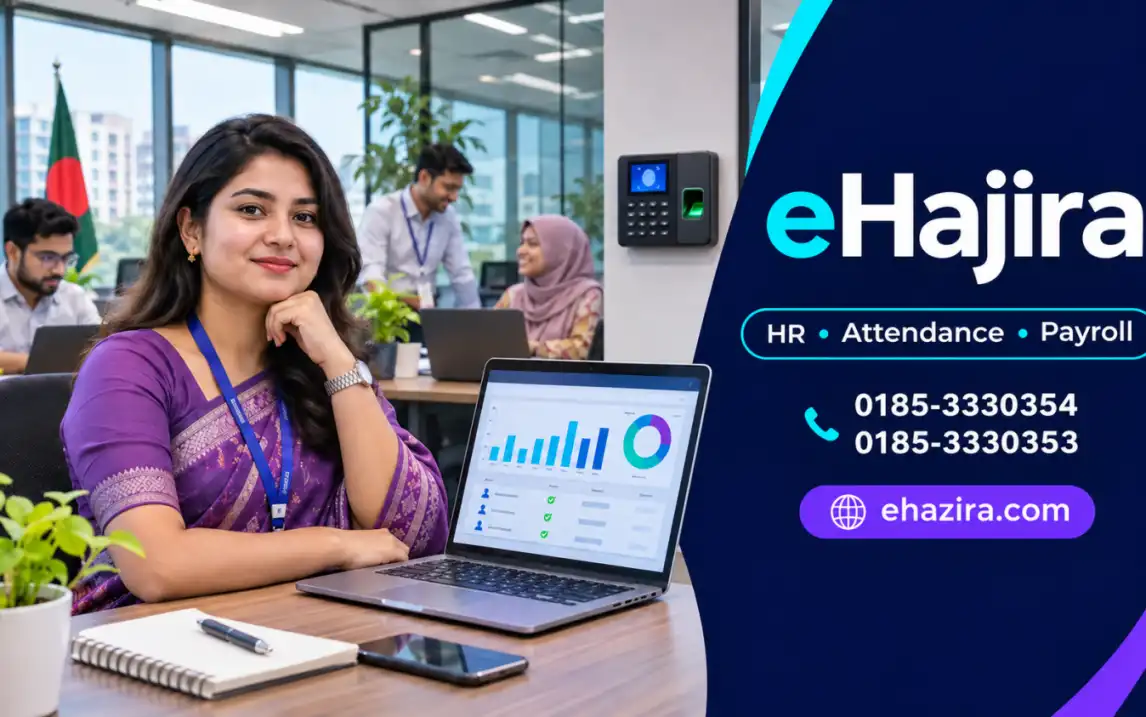
eHajira supports multi-branch employee management by bringing attendance from individual branches into a central system, with branch-level and organization-wide reporting. Its published multi-branch feature page describes separate branch devices managed within one account. [1] The practical value comes from combining that visibility with clear responsibilities, reliable employee records and tested approval rules.
This guide explains the operational use cases, implementation priorities and purchasing questions relevant to Bangladeshi businesses. Examples are illustrative workflows, not independently verified customer results.
Why Multi-Branch HR Management Needs a Different Approach
A growing business may operate a corporate office, several showrooms, a warehouse and a field-service team. Each location contributes employee information, but the head office remains responsible for consistent reporting and payroll preparation.
Consider a retailer with an Uttara office, two Dhaka showrooms and a Gazipur warehouse. Office staff follow a daytime schedule; showroom employees rotate opening and closing duties; warehouse personnel may work longer operational windows. A single attendance rule applied without considering these differences can produce misleading exceptions.
The objective is to maintain a common employee identity and reporting framework while accommodating approved differences in working arrangements. Central oversight should help managers resolve problems promptly, rather than simply collect more information at month-end.
What Bangladesh Market Research Indicates
A review of local supplier websites shows that attendance, leave, payroll, shifts and employee self-service are recurring elements of HR software offerings. PiHR publicly lists attendance, employee management, shifts, payroll, tracking and task management. Smart HRM describes multi-unit functionality, approval controls and configurable HR processes. [4][5]
These published offerings indicate that buyers have alternatives across overlapping functional categories. They do not establish vendor market share, implementation quality or equivalent package coverage. Claims such as “best” or “error-free” should not substitute for operational testing.
For a multi-branch buyer, the useful comparison is therefore specific: can the supplier demonstrate your employee transfer, overnight shift, branch restriction and payroll reconciliation scenarios? A product with many modules can still be unsuitable if the most important cross-branch workflow remains unclear.
Local support arrangements also deserve attention. Remote training, device commissioning and physical visits may have different commercial terms. Request a written scope covering every location rather than assuming that support for head office automatically includes all branches.
1. Central Visibility Without Losing Branch Context
eHajira’s multi-branch documentation describes both individual branch reports and an overall organizational view. [1] This provides a basis for reviewing local attendance while keeping a consolidated perspective.
In practice, central HR should establish a daily review routine. Identify missing attendance records, confirm whether an employee is on approved leave, and request clarification from the responsible manager. Review record freshness before treating a missing punch as an absence.
Branch labels should be consistent across employee profiles, device assignments and exported reports. Names such as “Uttara Office” and “Uttara Showroom” should represent clearly defined locations. Ambiguous naming makes comparisons unreliable and increases the risk of sending a correction request to the wrong supervisor.
A consolidated view is most valuable when every exception has an owner and a resolution deadline.
2. A Consistent Employee Identity Across Locations
The product’s documented scope includes employee profiles, departments and designations. For implementation, build an agreed employee master list before connecting branch data.
Assign each employee a unique identifier and verify their current branch, reporting manager and employment status. Check imported records for duplicate names and old device identifiers. Two people with the same name must remain distinct; one person moving between locations should not become two active employees.
Maintain a controlled process for updating essential records. Branch managers can identify changes, while designated HR administrators verify and apply them according to the agreed permissions. This reduces uncertainty over which spreadsheet or message contains the latest information.
Reliable employee identity is the foundation for meaningful attendance reports and consistent payroll inputs.
3. Attendance Devices at Multiple Branches
Separate locations may already use different biometric devices. eHajira supports branch-based device attendance, but buyers should validate each model, firmware version and connection method before rollout. [1]
Prepare a device inventory containing the location, model, network arrangement and person responsible for troubleshooting. Test an ordinary punch, a missing connection and delayed log delivery. Confirm how duplicate records and mismatched employee IDs are handled.
Attendance-log collection and biometric-template transfer are different functions. The owner identifies Device Sync as a Premium feature; compatibility must be confirmed for the actual hardware. Do not assume that importing attendance proves fingerprints or face templates can move between every device.
For an employee temporarily working at another branch, test authorization and identity mapping before the assignment begins. This avoids manual reconciliation later.
4. Branch-Specific Shifts and Working Arrangements
eHajira’s owner-confirmed capabilities include day, night and rotational shifts. These functions are relevant when different business locations have different operating hours.
Before configuration, document each employee group’s schedule, weekly rest arrangements and approved exceptions. A showroom closing shift should not be evaluated using an office arrival time. Likewise, an overnight warehouse shift needs a clear workday allocation when attendance crosses midnight.
During the pilot, test a shift change, a missing checkout and an employee temporarily covering another location. Verify how the selected configuration treats each case. Detailed rules should be agreed before using attendance results as payroll inputs.
Good scheduling depends on operational ownership. Assign a responsible person to maintain each roster and communicate approved changes before employees begin the affected shift.
5. Leave Management and Local Staffing Coverage
Leave becomes harder to coordinate when approval decisions and staffing needs sit in different locations. eHajira includes leave applications and approval workflows within its documented product scope.
A useful operating process begins with the employee submitting a request. The responsible manager considers local coverage, while HR verifies the applicable balance and policy. Configure and test the approval arrangement available in your package rather than assuming every organization uses the same hierarchy.
Define what happens when an approver is unavailable. Also test cancellation of approved leave and correction of an attendance status after approval. These exceptions matter because an unresolved leave record can affect both staffing decisions and salary calculations.
A consistent process gives employees a clearer view of request status and reduces informal follow-up between branches.
6. Transfers and Promotions With Clear Effective Dates
The eHajira website lists branch transfers and promotions with history. [2] For a growing organization, that capability can support movement between locations without relying exclusively on disconnected documents.
The business must still define the effective date, receiving manager, applicable schedule and responsibility for reviewing the transition period. Confirm that attendance before the transfer remains understandable and that access changes take effect as intended.
For example, a salesperson moving from a Dhaka showroom to Chattogram halfway through a month may have outstanding attendance corrections. Agree which manager reviews those earlier records. Also verify how reports allocate the employee when filtering historical periods.
Temporary assignments and permanent transfers should be treated distinctly. Ask for a demonstration of both cases before deciding how to configure them.
7. Role-Based Access and Management Accountability
eHajira publishes role and permission features. [3] The implementation question is how those controls map to your organizational responsibilities.
Central HR may require employee administration across branches. A showroom manager may need local attendance and leave review. Finance may need approved salary information without receiving responsibility for editing shifts. Employees generally need access to their own relevant records.
Treat this as a permission design exercise. Test ordinary accounts for each role, including exported files and direct access to employee records. Confirm that restricted information stays restricted after a transfer or change of manager.
Review access when someone leaves the organization or changes responsibilities. A central system becomes easier to govern when permissions reflect current duties rather than accumulated access granted over time.
8. Payroll Coordination Across Branches
eHajira Cloud includes payroll within its broader product offering. Accurate payroll still depends on the quality of employee data, attendance reconciliation and approved adjustments.
Use a defined monthly sequence: branch managers resolve local exceptions, HR checks attendance and leave, and finance reviews salary outputs. Verify allowances, approved overtime, advances and other applicable components before final approval.
Run a parallel payroll calculation during implementation. Compare selected employees from every branch against independently checked expectations, including a joiner, a transfer and an unpaid-leave case. Investigate differences before expansion.
Branch payroll reporting should also match the business’s cost allocation requirements. Do not assume that consolidated attendance automatically provides detailed accounting integration or separate legal-entity payroll processing. Establish those requirements explicitly in the implementation scope.
9. Supporting Employees Who Work Outside the Branch
Multi-branch businesses often employ technicians, sales representatives and installation teams. Their work may begin at a branch and continue at customer sites. The eHajira catalogue includes mobile GPS and selfie attendance, location tracking and tasks. [6]
Define the business purpose of each workflow. A mobile attendance record establishes an attendance event; a route record shows reported movement; a task update describes work progress. None independently proves service quality or customer acceptance.
The owner reports that GPS-off periods cannot be reconstructed later. When GPS remains enabled but internet is unavailable, location points can be buffered and uploaded after reconnection. This does not establish offline attendance punching support.
Explain tracking arrangements to employees, limit viewing to appropriate roles and test behavior on the actual phones used by field teams.
10. Reports That Lead to Practical Decisions
Reports become useful when managers know what action to take. Instead of reviewing only a total attendance percentage, examine unresolved exceptions and the operational reasons behind them.
Management question | Recommended review |
|---|---|
Which branch needs attention today? | Missing records, leave coverage and device connectivity |
Why are overtime inputs increasing? | Rosters, workload and approved overtime records |
Are transfers creating confusion? | Effective dates, employee mapping and supervisor ownership |
Is payroll ready for review? | Outstanding corrections and unapproved adjustments |
Are managers resolving requests promptly? | Pending applications and agreed escalation deadlines |
These are recommended review priorities; confirm the available report fields and filters during the demonstration. Where an indicator is not directly available, determine whether a controlled export can support the analysis.
Compare similar employee groups and reporting periods. A field-service branch and a head office may have different working patterns, so a raw ranking can conceal more than it explains.
A Practical Bangladesh Deployment Example
Imagine a business with 90 employees across a Dhaka head office, two showrooms and a Gazipur warehouse. This is an illustrative scenario, not a customer case study.
The project team first cleans employee IDs and assigns each person to a location and supervisor. It documents office, showroom and warehouse schedules, then tests the existing attendance devices. A small pilot covers one location and a selection of exceptional cases.
Next, managers review attendance corrections and leave requests through the agreed process. HR reconciles the pilot results, while finance completes a parallel salary calculation. The team also tests a transfer and checks whether an ordinary branch manager can access unrelated employees.
After acceptance, the remaining locations follow the same configuration checklist. Success is measured against the organization’s baseline: fewer unresolved exceptions, faster reconciliation and clearer accountability. No fixed savings percentage should be promised without actual measurement.
Package Selection, Costs and Implementation Scope
The public eHajira pricing page positions its Business plan for multi-branch organizations and lists BDT 6,500 monthly, with an annual-billing equivalent of BDT 5,200 monthly. It lists up to 300 employees. These are published terms, not a binding quotation. [6]
Confirm branch and device allowances, enabled modules, setup fees, applicable taxes, support coverage and payment terms. Also clarify whether Premium Device Sync is included in the proposed configuration. Package names alone do not answer these questions.
Request a rollout plan that includes data preparation, device testing, permission setup, training and acceptance criteria. Agree on ownership of corrections during the transition. A lower subscription can become less attractive if essential setup work remains outside the quoted scope.
Frequently Asked Questions
1. What is multi-branch employee management?
It is the coordinated management of employee information and HR processes across several locations, with local responsibilities and an organization-wide reporting framework.
2. Does eHajira support multiple branches?
Yes. Its published multi-branch page describes branch devices, branch-specific reports and centralized management through one account. Confirm the appropriate subscription and implementation scope.
3. Can head office review attendance from different locations?
Yes, the documented feature supports consolidated attendance visibility. Check connectivity and synchronization status before interpreting missing records as employee absence.
4. Can every branch use its own attendance device?
The published arrangement supports separate branch devices. Actual compatibility depends on the device model, firmware and connection method, which should be tested.
5. Can branches use different working schedules?
eHajira includes shift management. Demonstrate your specific office, showroom, warehouse or overnight schedules to verify the required configuration before rollout.
6. Can employees transfer between branches?
The website lists transfer and promotion history. Confirm effective dates, reporting treatment, supervisor changes and the handling of unresolved records during a transfer.
7. Will transferred employees need duplicate profiles?
A sound implementation maintains a consistent employee identity. Ask the implementation team to demonstrate transfers without duplicate active records or conflicting device mappings.
8. Can branch managers see only their teams?
Role-based controls are published, but exact access boundaries require configuration and testing. Include employee records, payroll details and exports in the permission test.
9. Can finance manage payroll centrally?
Cloud payroll can support centralized processing within the agreed scope. Finance should review approved branch inputs and validate calculations before finalizing salaries.
10. Is multi-branch the same as multi-company?
No. Several branches may belong to one company. Separate legal entities can require distinct records, payroll administration and access arrangements that need explicit confirmation.
11. Is eHajira suitable for retail chains?
It is relevant to retailers needing attendance, employee records and shift coordination across locations. Test opening and closing shifts, temporary coverage and branch reporting.
12. How can ISPs use it across service areas?
ISPs can evaluate mobile attendance, tasks and field-location features alongside branch records. Customer visits and emergency support shifts should be included in the pilot.
13. Can factories and head offices use one HR framework?
A shared framework can coordinate records while accommodating different schedules. Verify factory-specific shifts, overtime processes and reporting needs rather than assuming office settings apply.
14. Does mobile tracking work when GPS is off?
According to owner-confirmed behavior, positions are unavailable during GPS-off periods. Turning GPS on later does not recreate those missing locations.
15. What happens when internet connectivity is interrupted?
Behavior depends on the workflow and device. Location buffering with GPS enabled does not mean every attendance or approval function works offline; test each separately.
16. Does Device Sync work with all biometric devices?
No universal compatibility should be assumed. The owner identifies it as a Premium capability; validate supported transfer functions using your exact hardware and firmware.
17. Can employees review their own information?
The public catalogue includes employee self-service. Confirm which attendance, leave and payslip functions are available in the selected package and application.
18. Is employee attendance a complete productivity measure?
No. Attendance describes recorded presence and timing. Assess service quality, work completion and customer outcomes separately using appropriate operational evidence.
19. How much does multi-branch implementation cost?
Total cost depends on the subscription, employee count, devices, locations and setup requirements. Request an itemized quotation instead of budgeting from the monthly subscription alone.
20. Should every branch launch on the same day?
A phased rollout is often easier to validate. Pilot representative workflows first, resolve exceptions and then apply the approved configuration to additional locations.
21. Is eHajira Desktop equivalent to Cloud?
No. The owner describes Desktop as a separate Windows product without payroll or a mobile app. This guide concerns the Cloud offering and its multi-branch scope.
22. Does the system guarantee legal compliance?
No software purchase alone establishes compliance. Employers must verify applicable requirements and configure their employment policies and processes accordingly.
23. How should we measure implementation success?
Compare reconciliation time, outstanding corrections and payroll adjustments against your own baseline. Include employee usability and manager response times in the review.
24. How can we request an eHajira demonstration?
Call 0185-3330354 or 0185-3330353, or visit https://ehazira.com/. Share your employee count, branch list, device models and essential workflows.
Build a Connected Workforce Management Process
Multi-branch growth should make employee administration more structured, not more fragmented. eHajira provides a relevant foundation for connecting branch attendance with HR, shifts and payroll workflows. The strongest results depend on clean records, appropriate permissions and a disciplined review process.
Start with a demonstration based on your actual locations and employee scenarios. Confirm the commercial scope, validate the pilot and expand with clear responsibilities for each branch.
Discuss your multi-branch requirements: 0185-3330354 | 0185-3330353
Website: ehazira.com
লেখক
eHajira Team
eHajira টিম
মন্তব্য
এখনো কোনো মন্তব্য নেই।