Why eHajira is the best HR, Attendance ও Payroll Software in Bangladesh
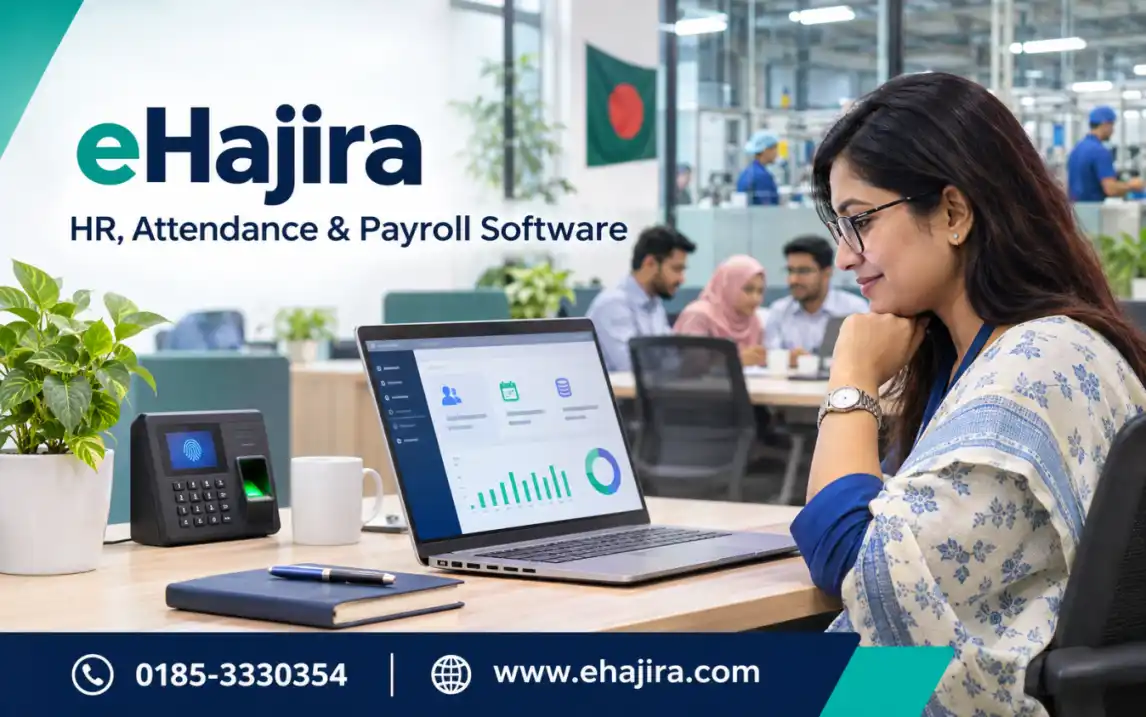
eHajira helps Bangladeshi organizations manage employee records, biometric attendance, shifts, leave, payroll and reports through a connected platform. It can support SMEs, offices, factories, schools, hospitals and multi-branch businesses, including teams with field staff. By reducing manual data entry and improving visibility into attendance exceptions, it can make HR and payroll workflows more
For many Bangladeshi employers, attendance and payroll still depend on a mix of paper registers, spreadsheets, biometric machine exports and last-minute messages. Each tool may work by itself, but the handoffs create avoidable work: a missed punch needs checking, approved leave must be reflected in attendance, overtime needs validation, and payroll staff must reconcile the final figures before payday. When a company adds branches, shifts or field employees, the process becomes harder to control.
eHajira is a Bangladesh-focused HR, attendance and payroll platform designed to bring these everyday processes into a connected workflow. It combines employee records, attendance synchronization, leave and shift administration, payroll functions, employee self-service, reporting and mobile features, subject to the selected package and configuration. Its value is not simply that it replaces a register with a screen. It gives HR and management a shared operational record they can review, correct through defined processes and use to prepare payroll more consistently.
Does that make eHajira the best HR software for every organization? No single platform is automatically best for every employer. The right choice depends on workforce size, payroll rules, device compatibility, support expectations and data governance. eHajira is a strong choice for Bangladeshi organizations that want attendance and HR operations linked to local work patterns, with room for biometric and mobile attendance. The sections below explain why—and what a buyer should verify before subscribing.
Why HR software matters in Bangladesh
The Bangladesh employment landscape includes garment and manufacturing units, offices, hospitals, schools, retailers, service companies, ISPs and teams working across customer locations. These organizations do not share one attendance pattern. A factory may operate day, night and rotational shifts; a school may need a fixed academic calendar; a service company may have office staff and field technicians; a retail group may need branch-level visibility. A manual process can handle a simple case, but it often becomes difficult to apply consistently across teams.
Digital HR administration helps centralize employee information and standardize recurring actions. It can reduce duplicate data entry, make attendance exceptions easier to identify, and give authorized managers a clearer view of leave, shifts and payroll inputs. It can also support better documentation. This matters because Bangladesh’s labour framework includes requirements and prescribed records relating to working time, attendance, overtime and wage statements. The Department of Inspection for Factories and Establishments lists, among other items, a daily attendance and overtime register and wage register and wage slip in its record guidance. Employers should confirm the current law, rules and sector-specific obligations with a qualified adviser; software can help organize records, but it does not certify compliance.
What eHajira brings together
1. Biometric attendance with connected employee records
Organizations already using biometric devices can reduce the manual step of exporting logs and rebuilding attendance sheets. eHajira’s published package information describes biometric or RFID attendance synchronization and compatibility with supported ZKTeco devices. The software can bring employee profiles and attendance activity into the same operating environment, helping HR teams review who attended, when exceptions occurred and which records need correction.
Device models, communication mode, firmware, network setup and package entitlement all matter. Before purchasing, give the provider the exact device model, number of terminals, branch topology and whether the devices connect by local network or ADMS. Request a live integration demonstration using your own sample workflow. Compatibility should be verified for the specific model and configuration rather than assumed from the brand name alone.
2. One employee profile for day-to-day HR
A useful HR system keeps key employee information organized: identity and contact details, department, designation, joining information, documents, roles and branch assignment. When the same record supports attendance and payroll operations, HR staff have fewer places to update. Access controls can also help ensure that managers see the information needed for their responsibilities while sensitive records remain restricted to authorized users.
This is especially practical for businesses that have outgrown separate spreadsheets maintained by HR, accounts and branch supervisors. A central record makes it easier to keep employee information current and to trace which employee is assigned to which team or location. Organizations should still define who may create, edit, approve and export employee data.
3. Shift and roster administration for local operating patterns
Bangladesh employers often need more than a single 9-to-5 schedule. Factories, hospitals, security teams, call centers and support operations can use day, night, rotating or branch-specific shifts. eHajira’s package listings describe shift and roster management, including multi-shift scheduling in applicable packages. That gives administrators a structured way to assign working schedules and compare attendance against the plan.
A configurable schedule helps reduce confusion over late arrival, early departure and overtime. But accurate results depend on correct setup: shift start and end times, grace periods, holidays, weekly rest days, overnight-shift rules and approval processes all need to be agreed before go-live. Run sample calculations for at least one normal day, one overnight shift, one weekly holiday and one approved schedule change.
4. Leave and attendance in the same workflow
Leave administration is more reliable when an application, approval and attendance record are connected. Employees can submit a request, the appropriate manager can approve or reject it, and HR can review the resulting status against the attendance calendar. eHajira supports leave workflows in its product scope. In practice, the organization must define leave categories, balances, eligibility, approval authority and how approved leave should appear in reports and payroll.
A connected workflow can reduce the common mismatch where a manager approves leave in a message but a separate attendance sheet still marks the employee absent. For implementation, test approved, rejected, cancelled and retroactively approved leave. Also check how the system handles partial-day leave and leave spanning a holiday, based on the organization’s policy.
5. Payroll preparation built from attendance inputs
Payroll is one of the most sensitive monthly workflows. eHajira’s payroll-enabled packages describe automated payroll processing and payslip generation. Attendance, leave, shift and overtime inputs can help payroll teams prepare calculations with less manual re-entry. Reports and exports can support review, approval and recordkeeping, depending on the selected package.
Automation does not remove the need for payroll governance. The employer should confirm salary components, allowances, deductions, overtime rules, rounding, salary periods, arrears, advances, tax treatment and approval steps. Before using live payroll, run parallel calculations for one or more completed payroll periods and compare the results against approved payroll records. Do not treat an automated figure as final until the responsible finance and HR staff have reviewed it.
6. Multi-branch and management visibility
A business with multiple offices, showrooms, schools, clinics or factory units needs to know whether each location is following the same process. A centralized dashboard can make it easier for head office to review attendance summaries, staff lists and exceptions while local managers focus on their teams. eHajira’s product information describes cloud-based access and multi-branch features in its broader offering; exact branch limits and entitlements should be confirmed for the package being quoted.
The operational gain is consistency: the organization can maintain shared rules while still assigning teams and schedules by branch. This can be valuable to growing SMEs that need better oversight but do not want to consolidate every decision at head office. Role-based access and clear approval ownership remain essential.
7. Mobile attendance and field-team workflows
Not every employee starts and finishes work at a fixed desk. Sales representatives, technicians, delivery teams and project staff may work at customer sites. eHajira’s mobile app has supported attendance and field-work capabilities such as mobile check-in, location-related functions and task workflows, based on the configured version and subscription. These can help managers coordinate dispersed teams and review submitted work activity.
Location features require transparent policies. Employers should tell employees what location data is collected, when collection happens, who can view it, how long it is retained and how employees can raise a concern. GPS attendance can support a work process; it should not be presented as proof of all-day productivity or used without clear notice and a legitimate business purpose. Organizations must obtain appropriate advice on privacy and employment obligations.
8. Reports and exports for operational review
Useful reports turn raw punches into management information. Daily and monthly attendance reports can help teams review presence, lateness, leave, overtime and exceptions. Excel or PDF exports, where available in the chosen plan, allow the organization to maintain a review workflow and share approved summaries with relevant teams. Reports are only dependable when the underlying attendance rules and employee data are clean.
Managers should decide which reports are reviewed weekly, which require approval before payroll and which are kept for audit or internal reference. A short exception queue—missing punch, unusual overtime, unassigned shift or pending leave—often has more operational value than a large collection of dashboards no one checks.
Why eHajira can be the best-fit option for Bangladeshi organizations
The case for eHajira rests on fit, not a universal ranking. First, it is positioned around the problems local employers routinely face: biometric attendance, shift variation, leave processing, payroll preparation and branch oversight. Second, it can connect supported attendance devices with HR workflows, which is important for businesses that have already invested in biometric terminals. Third, package options can address different employee ranges and feature requirements. Its public product catalogue currently shows tiered packages and describes different inclusions, so buyers should compare the live quotation with their actual requirements [3].
Fourth, a Bangladesh-based provider can make implementation conversations, device setup and user training easier to coordinate in the local business context. A buyer should still evaluate support response time, service coverage, backup arrangements and escalation channels in writing. Fifth, a mobile option can help organizations whose workforce includes field staff or employees who need self-service access, while web-based administration supports HR and management teams.
These strengths make eHajira a credible shortlist candidate for SMEs, corporate offices, service businesses, schools, clinics, manufacturing units and multi-branch operations. The best-fit decision should come after a demo using the buyer’s real rules: sample shifts, devices, leave policies, payroll components and approval hierarchy. Published features establish a starting point; a written scope, implementation plan and acceptance checklist establish what the customer will actually receive.
How to evaluate and implement eHajira
Start with a short requirements workshop. List employee groups, branches, shifts, attendance devices, payroll components, leave types, report needs and approvers. Next, ask for a demonstration that follows a complete monthly cycle—from employee setup and device punch through exception review, leave approval, payroll calculation and payslip output. Confirm which features are included in the quoted package and which may require setup or integration charges.
Then pilot one department or branch. Import a controlled set of employee records, test the devices, validate shifts and leave, and compare sample payroll results to approved historical data. Train HR, finance, managers and employees on the actions they need to perform. Before launch, document access roles, data correction rules, backup responsibility, support contacts and employee notices for any location features. Review the first payroll close jointly and record adjustments for the next cycle.
Conclusion
eHajira can be a strong HR, attendance and payroll software choice in Bangladesh because it brings connected tools to practical local workflows: biometric attendance, employee records, shifts, leave, payroll, reports, branch operations and mobile field work. The fit is strongest where an employer wants to reduce spreadsheet handoffs and build a more consistent process across teams or locations.
The right buying decision still depends on package scope, device compatibility, payroll rules, user access, support and data practices. Evaluate eHajira against those criteria, test your own scenarios and confirm all inclusions in writing. With a careful implementation, an HR platform can give Bangladesh businesses a more dependable operating foundation for workforce administration.
Frequently asked questions
1. What is eHajira?
eHajira is an HR, attendance and payroll software platform from Trimatrik Multimedia. Its feature scope includes employee administration, attendance, shifts, leave, payroll and reporting, with package-dependent capabilities.
2. Is eHajira suitable for small businesses in Bangladesh?
It can suit small businesses that want organized employee records and attendance, with payroll or self-service features selected according to need. Confirm the employee limit, included modules and setup cost in the current quotation.
3. Can eHajira connect to biometric attendance machines?
Published package details describe biometric or RFID synchronization with supported devices, including compatible ZKTeco models. Share your exact model and connection method for confirmation before buying.
4. Does eHajira support face recognition attendance?
Some compatible terminals use face recognition, but device support depends on the model and integration method. Ask for a demonstration with the exact terminal and confirm the supported features in writing.
5. Can eHajira manage multiple branches?
The broader offering includes centralized and multi-branch workflows. Confirm the branch count, access controls and any package limits with the provider for your proposed subscription.
6. Does eHajira include payroll?
Payroll is available in payroll-enabled packages. Confirm salary processing, payslips, required calculations, employee capacity and reports included in the package you are considering.
7. Can payroll be calculated automatically from attendance?
Attendance and payroll workflows can reduce manual transfer of inputs, but the outcome depends on configured salary rules and package scope. Validate sample calculations with HR and finance before going live.
8. Can eHajira calculate overtime?
Overtime-related records and reporting may be available according to configuration. Confirm how overtime eligibility, rates, approvals, overnight shifts and rounding will be set for your organization.
9. Can it handle night and rotating shifts?
Package information describes multi-shift scheduling in applicable plans. Test overnight shifts, weekly rest days, public holidays and shift changes using your real roster before implementation.
10. Can employees apply for leave online?
The system supports leave request and approval workflows within its HR scope. Your administrator should configure leave types, balances, eligibility and approving managers before employee access begins.
11. Can approved leave update attendance records?
A connected leave and attendance process is intended to reduce mismatches. During the demo, test approval, cancellation and retroactive leave so you understand how each case appears in reports and payroll inputs.
12. Does eHajira provide an employee self-service portal?
Some package listings include an employee self-service web portal, and mobile access may vary by plan and version. Confirm the employee functions available in your subscription.
13. Is there a mobile app?
eHajira has a mobile app with features such as attendance and field-work workflows, depending on version and entitlement. Confirm the current app release, supported devices and enabled modules.
14. Can field employees check in using GPS?
Mobile attendance and location-related workflows may be available in the configured service. Employers should provide clear employee notice, define when location is collected and limit access to authorized users.
15. Does eHajira work without internet?
Internet needs depend on the device setup and feature being used. Confirm offline behavior separately for biometric device logging, mobile attendance, GPS uploads and web administration; these functions should not be assumed to behave identically.
16. Can reports be exported to Excel or PDF?
Published package information lists Excel and PDF exports for some plans. Ask which reports and export formats are included, and check whether the output matches your internal review needs.
17. Does using eHajira make an employer compliant with Bangladesh labour law?
No software alone guarantees compliance. Employers remain responsible for applicable laws, rules, record retention, wage calculations and workplace policies. Use the system to support records and seek qualified legal or HR advice.
18. How secure is employee data in eHajira?
Before adoption, ask for written details on hosting, encryption, backups, access controls, data retention, incident handling and account recovery. Assign roles carefully and review access periodically.
19. How long does implementation take?
Timing depends on employee data quality, device integration, shift complexity, payroll setup, branches and training. Agree a written implementation plan with milestones, responsibilities and acceptance criteria.
20. What should we prepare before requesting a demo?
Prepare your employee count, branches, device models, sample shifts, leave policy, salary components, approval structure and reports. A realistic scenario lets both sides assess fit efficiently.
21. Is eHajira only for factories or garments?
No. Its workflows can be relevant to offices, SMEs, hospitals, schools, manufacturing, service teams and multi-branch businesses. The configuration should reflect each organization’s operating rules.
22. How much does eHajira cost in Bangladesh?
Price depends on employee capacity, package, modules, implementation and device integration. The public product catalogue contains tiered listings, but request a current quotation and verify all recurring and one-time charges.
Contact eHajira
Phone: 0185-3330354
Website: https://www.ehajira.com
Written by
eHajira Team
The eHajira team
Comments
No comments yet.